
Twelve Icons
Partner casino · 500% up to ₹1 lakh on deposit one · 18+
Pappu Playing Pictures runs on twelve icons. Count them once, learn the art, then stop hunting for a thirteenth “secret” tile. The strip is the product: umbrella, football, sun, oil lamp (diya), cow, bucket, kite, spinning top, rose, butterfly, pigeon, rabbit.
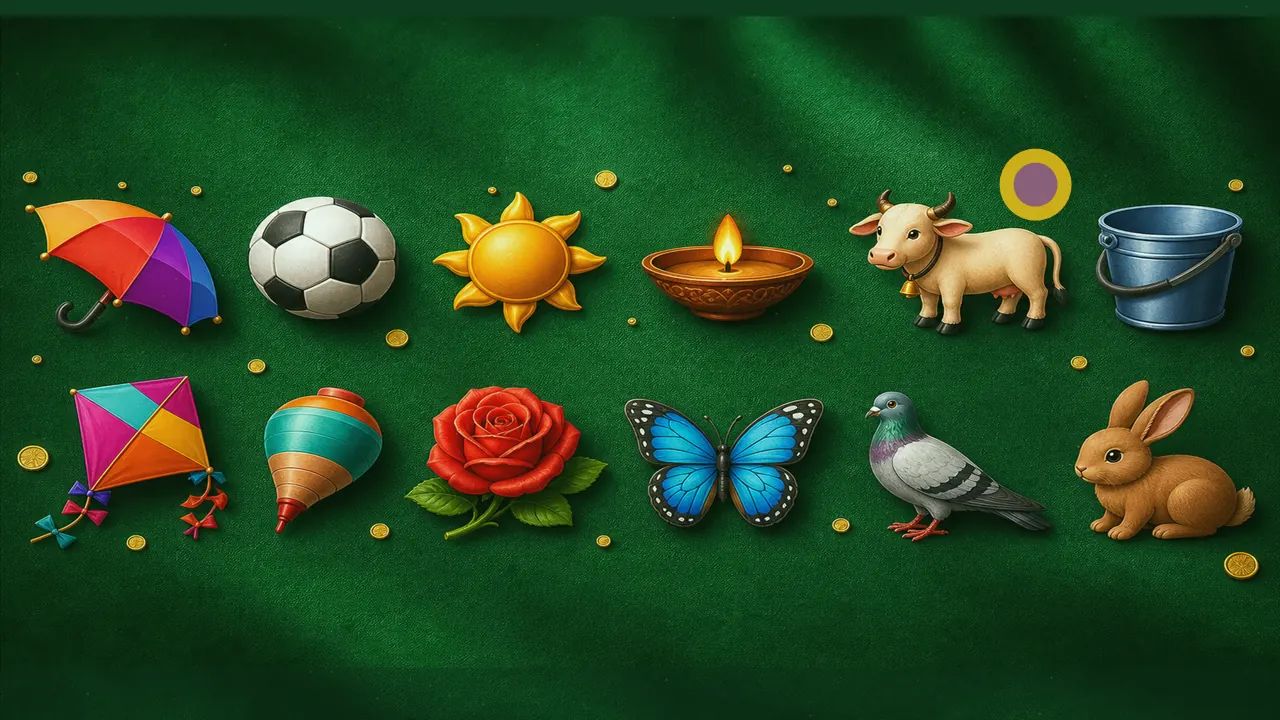
Every icon shares the same base match of ×10. Extra Pay can raise a tagged icon for one round. Multiple Mode lets you cover several at once. Neither feature invents a privileged picture with hidden odds.
Why twelve matters for India search
Many “Pappu” pages blur into colour games or satta slang. Twelve fixed pictures are the quickest authenticity check. If a wrapper shows three colour tiles and calls itself Pappu, walk away — vs colour prediction and original tile.
The labeled cousin of this page is the icon map, with everyday names. Use both: this page for the count and product claim, the map for recognition drills.
Still-life set, not a zoo of renames
Lobby screenshots set the names above. Blogs sometimes swap animals or add drums. Prefer what the live strip shows. When UI shorthand appears, cross-check glossary.
Festive art does not mean festival luck. A diya on Diwali week still settles like a bucket on any other week.
Coverage math starts with the count
One icon = one stake line. Six icons = six stake lines. Twelve icons = full-strip coverage and a fast burn. Players who “must cover everything because Extra Pay might appear” usually hit their session cap early. Read Pappu Game payout before you treat the full strip as default.
Practice the set, not a favourite
On Pappu Game demo, cycle the full twelve across a session. Mark which two you confuse under time pressure. Revisit those until the settle line is readable even when the timer feels short. Product framing continues on Pappu Playing Pictures game and what is Pappu Game.
The set, named plainly
Umbrella, football, sun, diya, cow, bucket, kite, spinning top, rose, butterfly, pigeon, rabbit. That is the whole set, and it does not change between rounds. No icon is added on a streak, none is removed after it is drawn, and none carries a different base match from the others. A round does not know what the previous round did.
This sounds obvious written down, and it is exactly the sentence that trick charts quietly deny. A chart with a "due" column is claiming the set has memory. It does not.
Why the count itself matters
Twelve is the number that makes coverage arithmetic easy to do in your head, which is useful, because coverage is where stake actually disappears. Cover one icon and you stake one chip. Cover six and you stake six chips every round, matched or not, for the same single draw. The draw does not get more generous because you bought more of the strip — the base match stays ×10 on whichever single icon arrives. That is the whole of Pappu Game payouts and the whole argument on Multiple Mode.
Everyday objects, not symbols
The set is deliberately ordinary — household and outdoor things anyone in India recognises without a legend. That is a design choice for speed of reading, not a code. Nothing about a diya or a cow carries meaning inside the round beyond "this is the picture that was drawn." Reading significance into the objects themselves is where folklore starts, and the history strip is the honest version of the same curiosity: a log of what came up, with nothing predicted.
FAQ
Are all twelve always available?
On standard lobbies, yes — the betting strip shows the full set each round.
Does one icon pay more at base?
No. Base is ×10 across the board.
Where do seals fit?
Extra Pay tags are temporary; they do not remove icons from the set.
Is “goat” one of the twelve?
Not on the lobby set this guide follows. Stick to the list above.
How do I teach a friend quickly?
Show the strip, say “one draw,” then open demo. Skip myth PDFs.
18+. Entertainment only. Twelve pictures are enough — do not invent a thirteenth system.